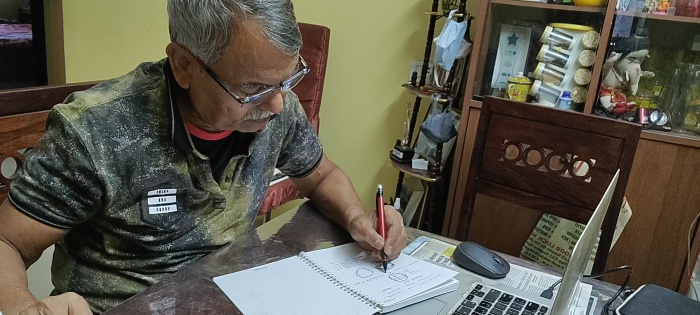
The poem illustrates how pain becomes poetry. It shows how sorrow and hidden scars can change into truth and healing. The poem highlights vulnerability, strength, and the power of heartfelt writing.
# My Wounds Became Ink #
I never learned to hide my pain,
it lived inside me like the rain,
quietly falling night by night,
until my darkness learned to write.
The tears I could not speak aloud,
the trembling heart behind the crowd,
the silent battles deep within—
my every wound became ink.
Some nights were heavy, cold, and long,
yet sorrow slowly shaped my song,
and every scar I tried to hide
became the place where words could shine.
I wrote of loss, I wrote of fear,
of holding on when none were near,
and somehow through the endless ache,
my weary soul began to wake.
I do not write because I know
how to escape from every sorrow,
I write because a hurting heart
still searches healing through its art.
Let my restless pen still think,
let honesty flow through every link,
All the truest words I ever bring
are born from wounds that turned to ink.
(Vijay Verma)
www.retiredkalam.com

Categories: kavita


very nice .
LikeLiked by 1 person
Thank you so much.
LikeLike
This is beautifully heartfelt Verma ji. The way pain transforms into poetry throughout the poem feels both honest and healing. Lines like ‘until my darkness learned to write’ and ‘my every wound became ink’ carry such emotional depth. A touching reminder that our deepest scars can become our strongest voice. Truly inspiring.🤍✨
LikeLike
Thank you so much for your kind and thoughtful words. 🤍 Your appreciation touches my heart deeply. I truly believe that pain, when embraced with courage and reflection, can transform into something meaningful. As you beautifully noted, “until my darkness learned to write” and “my every wound became ink” express that very journey—from suffering to expression, from silence to voice.
LikeLiked by 1 person
Very nicely written. But it proves something wrong, the pen (Kalam) has not retired you only retired from the job you were doing. Brave people sing out their pain.
LikeLike
Thank you so much for your thoughtful words. You are absolutely right—perhaps the job retired, but the Kalam never did. 😊 Writing has become a companion that grows stronger with time, giving voice to thoughts, memories, joys, and even pain.
I especially appreciate your observation that brave people sing out their pain. There is something healing about turning wounds into words and struggles into stories. If my writing resonates with others, then every line written has found its purpose.
LikeLiked by 1 person
A deeply moving poem, Verma ji. It beautifully shows how pain, when embraced with honesty, can transform into wisdom, strength, and art. The line “my every wound became ink” is especially powerful turning suffering into something meaningful and healing. A heartfelt tribute to the resilience of the human spirit. 🌹
LikeLiked by 1 person
Thank you so much for your kind and thoughtful words. Your interpretation touches the very heart of what I hoped to express. Pain, though difficult to endure, often becomes our greatest teacher, and when given a voice through writing, it can transform into wisdom, strength, and even beauty.
LikeLiked by 1 person
Most of my pain I turn to ink…love the way you describe how suffering can be meaningful.
LikeLiked by 1 person
Yes, turning pain into ink isn’t just expression—it’s transformation.
I’m really glad those lines connected with you. When suffering finds language, it often loses some of its weight and becomes something we can understand, maybe even carry a little more gently.
Thank you for reading with such feeling 🤍
LikeLiked by 1 person
I wonder if we proactively confront pain and loss or if we retroactively reflect on it after we have instinctusually done what needs to be done
LikeLiked by 1 person
I think it’s a bit of both—but not in equal measure, and not at the same time.
In the moment of pain or loss, most of us don’t “process” it in any neat or conscious way. We react. We do what keeps us functioning: we shut down, we push forward, we distract ourselves, we survive. That instinctive movement isn’t avoidance in a shallow sense—it’s the nervous system doing its job to get us through something too big to fully hold all at once.
LikeLike
You describe the catharsis of writing out our emotions beautifully! We need an outlet, and ink is one that that allows us to process. Love the line “until my darkness learned to write.”
LikeLiked by 1 person
You’re absolutely right: writing becomes a kind of quiet release, almost like the mind finally finding somewhere safe to set things down. What feels heavy inside often becomes lighter once it has words to lean on.
And maybe that’s the real magic—not that darkness disappears, but that it learns a language… and in doing so, stops feeling so alone.
LikeLiked by 1 person
“And maybe that’s the real magic—not that darkness disappears, but that it learns a language… and in doing so, stops feeling so alone.” Spot on! 👏
LikeLiked by 1 person
Thank you so much! 👏
I think that’s what writing has always done for me. It may not erase the shadows, heal every wound, or answer every question, but it gives those feelings a voice. Once they are expressed, they no longer remain locked away in silence.
LikeLiked by 1 person
I’m used to writing every day, and if I can’t, my mind suggest to penned down my thoughts to release them to the world, or just privately in my journal.
Keep writing, Verma. A lovely poem.
LikeLiked by 1 person
Keep writing, Verma. That pull to put words to paper — whether for the world or just yourself — is a quiet kind of courage. The mind knows when it needs to breathe, and a journal is a safe place for that breath to land.
LikeLiked by 1 person
A lot of truth in your poems–and I love that they rhyme! So many people avoid that anymore.
LikeLiked by 1 person
Thank you so much! 😊
I’m really glad the rhyme and rhythm stood out to you—it’s something that brings a certain flow and musicality to poetry, and it’s nice to know it still connects with readers who appreciate it.
LikeLiked by 1 person
Your poem is a bittersweet representation of what it means to be a writer sometimes. Writing is a healing craft, a craft that forces vulnerability and reflection. You’ve captured the painful yet soothing spirit that is writing.
LikeLiked by 1 person
Thank you for such a thoughtful reading of it. I really appreciate how you picked up on both sides of the process—the ache of vulnerability and the quiet healing that can come through it.
Writing does have that dual nature, doesn’t it? It asks you to open doors you might prefer to keep closed,
LikeLiked by 1 person
A poetic reflection—exploring how emotional pain transforms into creative expression, where sorrow and hidden wounds become healing, truth, and poetry itself. ✨📖💭
LikeLike
Thank you so much for your thoughtful reflection. 🌿✨
I truly believe that some of the most meaningful writing is born from experiences we never wished to have but somehow survived. Pain has a way of seeking expression, and when it finds its voice through words, it can become understanding, healing, and even hope.
LikeLike
This is a very interesting concept: transforming pain into poetry, dealing in this way with the scars we carry. I liked it.
LikeLiked by 1 person
Thank you so much for your thoughtful comment. 🌹
I’m delighted that the idea resonated with you. I have always felt that poetry has a unique ability to transform our wounds into wisdom and our pain into something meaningful. The scars we carry are part of our story, and when expressed through words, they can become not only a source of healing for ourselves but also a source of comfort for others.
LikeLiked by 1 person