
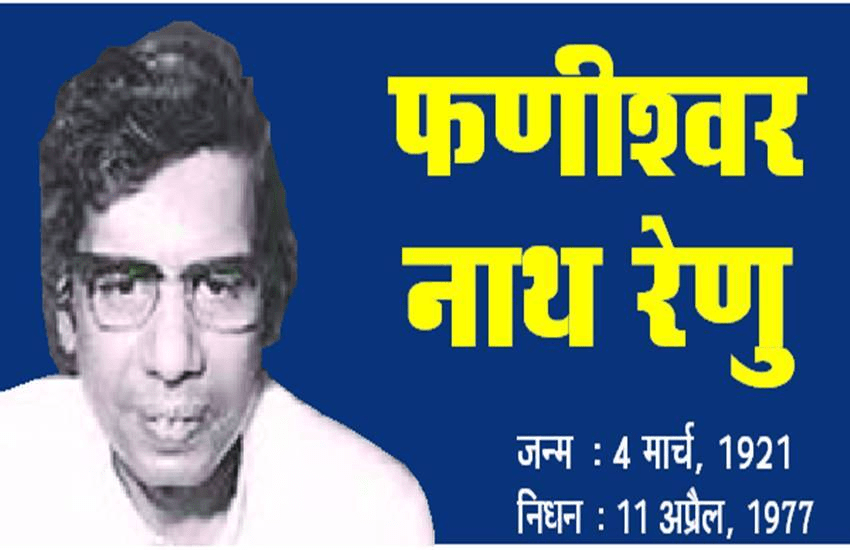
Phanishwar Nath Renu
Every year on September 14th, India bows its head in honor of Hindi—the language that was officially adopted in 1949 as the Republic’s own.
But Hindi Diwas is more than a date. It is a reminder of our collective identity, of stories passed down over generations, and of the dreams of countless voices strung together by words.
On this day, as we celebrate the vastness of Hindi, it is only fitting to remember one of its brightest storytellers—Phanishwar Nath Renu, the rebel writer, the chronicler of the soil, and the echo of the common people.
Born of the Soil, Born of Struggles
Renu’s journey began on March 4, 1921, in Araria, Bihar, amidst the humble yet resilient realities of rural India. His early education in India and Nepal brought him close to the land, its people, its dialects, and its struggles.
But Renu didn’t confine himself to books; he shouldered the torch of revolution. He fought for India’s freedom, threw himself into Nepal’s movement for democracy in 1950, and stood shoulder to shoulder with visionaries like Jayaprakash Narayan.
The fire of rebellion kindled in his heart never faded—it merely found a new medium: his pen. Through writing, Renu transformed his lived struggles into living literature.
“Maila Anchal” and Beyond: A New Language of Hindi
If Hindi binds India, Renu reshaped its very fabric. He brought ordinary lives into extraordinary prose, creating what we today know as anchalik sahitya (regional literature).
His masterpiece, Maila Anchal (The Soiled Linen), did not simply tell a story— it captured a heartbeat.
It carried the fragrance of Bihar’s soil, the rhythm of folk songs, the whispers of local dialects, and the cries of villages caught in poverty, injustice, and hope.
For the first time in Hindi literature, villagers were not “characters” to be pitied or romanticized; they were real, flesh-and-blood humans, with their laughter, longing, anger, and silence.
Renu’s pen gave them dignity. No wonder the novel earned him the Padma Shri, though he later fearlessly returned it as a protest against injustice. To him, truth was greater than honors.
His story Mare Gaye Gulfam later bloomed on screen as Teesri Kasam, with Raj Kapoor and Waheeda Rehman—an immortal film that carried Renu’s essence of longing and tenderness into the hearts of cinema lovers.
The Writer Who Could Write Sounds
What made Renu so magical was his ability to hear and make us hear. The croaking of frogs on a stormy night, the hum of insects in stillness, the thumping of a drum in a distant village fair—he etched them all into words.
To read him is to step inside a living village, to feel monsoon winds brushing past the banana trees, to smell the wet earth, to hear voices rising in song or protest.
But behind this poetry of sound lived a conscience that never slept. Renu was a fighter against exploitation, oppression, and corruption. His voice was not ornamental; it was a weapon of truth.
When Literature Became Resistance
Renu’s life and writing were never separate streams; they merged into one river of resistance.
During the days of political unrest in Bihar, he renounced his Padma Shri, calling it “Papashri”, turning the moment into a moral awakening for many. For him, awards meant little if democracy and dignity were attacked.
This was Renu’s essence—an artist who believed literature was not meant to weave illusions but to sharpen reality. His pen belonged to the people, not to power.
Renu on Hindi Diwas: A Living Tribute
On April 11, 1977, barely at the age of 56, Phanishwar Nath Renu breathed his last in Patna.
But legends do not die. As Nepal’s former Prime Minister Bishweshwar Prasad Koirala said, “Renu has not died; he lives on in the hearts of those who struggle.”
On a day like Hindi Diwas, when we honor the language as a thread that binds India, remembering Renu becomes more than a tribute—it becomes a responsibility.
He reminds us that Hindi is not hollow grandeur, nor just state recognition. Hindi is the voice of villages, bazaars, farmers, dreamers, and rebels. It is the sound of soil meeting sky, of stories born from reality and nourished in struggle.
The Legacy Lives
To read Renu is to realize that literature is life itself. His characters still walk beside us, laugh with us, and sometimes remind us of our own neighbors and families.
His villages are not confined to Bihar; they reflect every Indian heartland. His fearless honesty tells us what Hindi can achieve—not just as language, but as a spirit of unity, empathy, and courage.
This Hindi Diwas, as we celebrate the language of our identity, let us remember Renu—the man who gave Hindi the strength of the soil, the truth of the streets, and the music of the people.
For as long as Hindi lives, so will the voice of Phanishwar Nath Renu.
BE HAPPY….BE ACTIVE….BE FOCUSED….BE ALIVE…
If you liked the post, please show your support by liking it,
following, sharing, and commenting.
Sure! Visit my website for more content. Click here
www.retiredkalam.com
Categories: infotainment
 Retiredकलम
Nice blog on Phanishwar Nath Renu.
Short and informative.
LikeLiked by 2 people
Thank you so much, dear.
I’m glad you liked the blog on Phanishwar Nath Renu.
His life and works truly remind us how deeply Hindi literature is rooted in the soil and spirit of our people.
LikeLiked by 1 person
You made me curious..so I booked it and soon ready to read 🙏
LikeLiked by 2 people
That’s wonderful! I’m sure you’ll enjoy reading it—Renu’s writing has a way of pulling you right into the heartbeat of rural life.
Would love to hear your thoughts once you finish it!
LikeLiked by 1 person
very nice .
LikeLiked by 2 people
Thank you so much.
LikeLiked by 1 person
Nice post. Thank you.
LikeLiked by 2 people
You’re very welcome!
I truly appreciate your kind words — so glad you enjoyed the post. 😊
LikeLiked by 2 people
Great, मेरा भी अभिवादन उनको, हिन्दी को और आपको, देरी की माफी चाहते हैं l 🙏🙏
LikeLiked by 3 people
आपका बहुत-बहुत धन्यवाद 🙏💐
आपके स्नेहिल शब्द और सम्मान मुझे हमेशा प्रेरित करते हैं।
देरी के लिए बिलकुल क्षमा माँगने की ज़रूरत नहीं — आपका संदेश अपने आप में बहुत ख़ास है।
LikeLiked by 2 people