Hello dear friends,
I hope this blog finds you in a cheerful and peaceful mood. Today’s writing prompt presents a wonderfully imaginative question: “If you could have dinner with any philosopher, who would it be?”
At first, the question feels simple, but the more I thought about it, the deeper it became. After all, choosing someone to dine with is not only about admiration; it is about choosing a mind that challenges you, comforts you, and changes the way you look at life.
And for me, that person would undoubtedly be Gulzar Saheb.
More Than a Poet
Many people know Gulzar as a celebrated poet, lyricist, screenwriter, and filmmaker. But to me, he is also a philosopher hidden behind poetry.
Philosophers are not always those who write complicated theories or speak in difficult language.
Sometimes, they are the people who quietly explain life through emotions, silences, and simple observations. Gulzar Saheb has mastered that art beautifully.
His words often feel less like literature and more like reflections of our own hearts.
He speaks of loneliness, memories, love, separation, and hope in ways that feel deeply personal. Somehow, while reading his poetry or listening to his songs, one feels understood.
That, to me, is philosophy.
The Dinner I Imagine
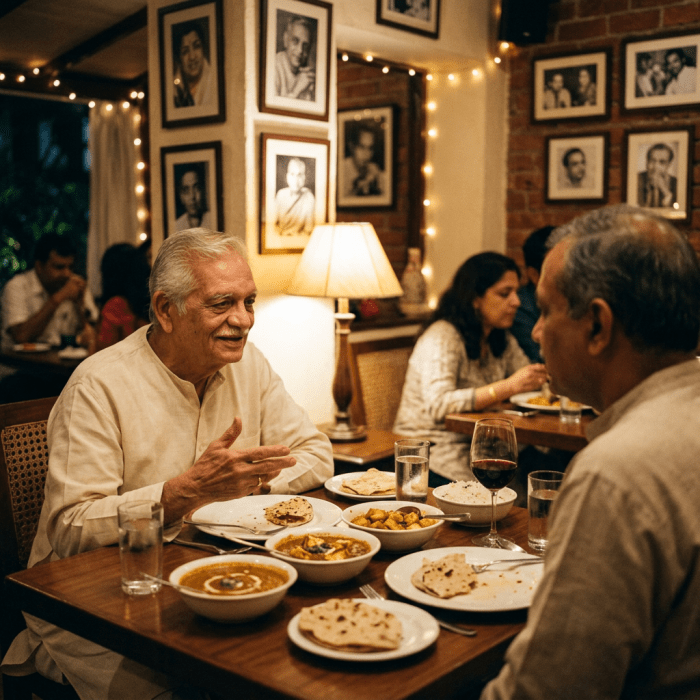
If I could truly have dinner with Gulzar Saheb, I do not imagine a luxurious setting. Instead, I picture a quiet evening in a small café while rain taps softly against the windows.
There would probably be tea before dinner, long pauses between conversations, and the comfort of silence that does not feel awkward.
Gulzar Saheb seems like someone who would notice tiny details—the sound of spoons against cups, an unfinished sentence, or the sadness hidden behind a smile.
And perhaps that is what I would admire most: his ability to observe life so gently.
Questions I Would Ask Him
I think I would ask him questions that many of us secretly carry within ourselves.
- Why do incomplete relationships stay in our hearts longer than complete ones?
- Why do memories become more beautiful after people leave?
- Why does silence sometimes hurt more than harsh words?
But I doubt he would answer directly. I imagine he would smile softly, recite a few poetic lines, or tell a small story from everyday life. Somehow, the answer would slowly unfold on its own.
Real wisdom rarely arrives loudly. It arrives quietly, like rain in the middle of the night.
His Philosophy of Small Things
One reason I admire Gulzar Saheb so deeply is because he teaches us to notice the small things we often ignore.
In today’s world, everyone is rushing—towards success, attention, validation, or the next destination. But Gulzar Saheb’s writing reminds us to pause.
- To watch sunlight falling on old walls.
- To listen to the sound of rain.
- To value handwritten letters and meaningful conversations.
- To sit alone sometimes without feeling lonely.
His philosophy is not about escaping life; it is about experiencing it more deeply.

Conversations About Pain
No meaningful dinner conversation is complete without discussing pain, because pain shapes every human being in one way or another.
I would ask him, “How does one continue loving life after heartbreak, disappointment, or loss?”
And perhaps he would explain, through poetry, that pain is not the enemy of beauty. In fact, pain often deepens our understanding of love, compassion, and humanity.
His writings never deny sadness. Instead, they embrace it softly and transform it into something beautiful.
That is why his words stay with people for years.
Why I Would Choose Him
There are many brilliant philosophers in history whose intelligence changed civilizations. Yet Gulzar Saheb feels different because his wisdom feels human.
He does not try to impress people with complexity. He simply reminds us of emotions we had forgotten how to feel.
- In a noisy world full of opinions, he teaches gentleness.
- In a world obsessed with certainty, he teaches acceptance.
- And in a world afraid of vulnerability, he teaches honesty.
My Final Submission
By the end of that imaginary dinner, I do not think I would leave with dramatic life lessons or magical answers. Instead, I would probably return home quieter, calmer, and more attentive to life itself.
And maybe that is the true purpose of philosophy—not to solve every mystery, but to help us live more meaningfully with the questions.
So yes, if I could have dinner with any philosopher, I would choose Gulzar Saheb—the man who turned ordinary emotions into timeless wisdom and taught generations that even silence can speak beautifully.
Thank you for reading, dear friends.
Until next time, keep finding poetry in ordinary moments.
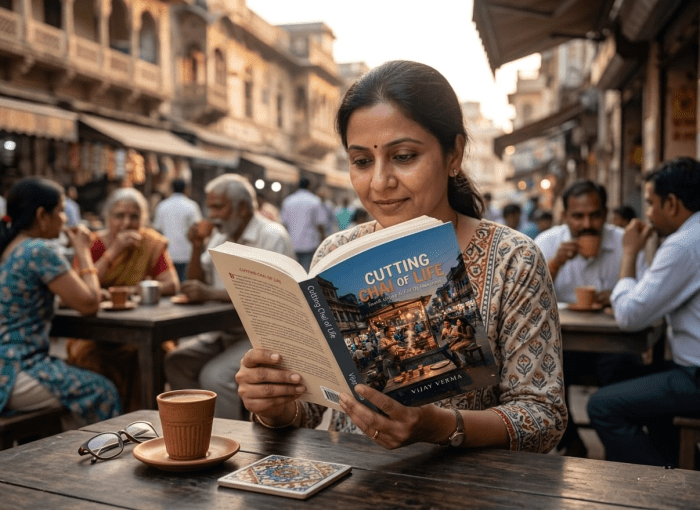
My book is now available on Amazon.
You can find it here: https://amzn.in/d/0gBYPlvz
I truly appreciate your interest and support—it means a lot!
Categories: infotainment


Dear Verma ji,
What a beautifully written piece—honest, gentle, and deeply reflective. Your choice of Gulzar Saheb as the philosopher for that imaginary dinner feels not just unique but profoundly wise. You’ve captured exactly why his words stay with us long after we’ve heard them: because they don’t lecture; they accompany us.
I especially loved how you described philosophy not as complex theories but as quiet observations of life—the sound of rain, the weight of silence, the sadness behind a smile. That’s the kind of wisdom that actually heals.
Your dinner scene was so vivid and tender. It made me want to sit at the next table, just to listen. And the questions you’d ask him? Those are the ones we all carry but rarely voice. Thank you for giving them space.
This line moved me the most: “Real wisdom rarely arrives loudly. It arrives quietly, like rain in the middle of the night.”
You’ve written something that feels like a warm cup of tea on a rainy evening—simple, deep, and unforgettable. Keep finding poetry in ordinary moments. You clearly already do.
With appreciation,
Srikanth
LikeLiked by 1 person
hank you so much for this deeply thoughtful and heartfelt response. 🌸 Your words touched me in a very special way. I’m truly moved that the piece resonated with you so personally and that you connected with the quiet spirit behind it.
You understood exactly what I hoped to express about Gulzar Saheb — that his wisdom feels less like instruction and more like companionship through life’s silences, sorrows, and small beautiful moments. Your reflection on philosophy as healing through ordinary observations is beautifully said.
LikeLike
very nice .
LikeLiked by 1 person
Thank you so much.
LikeLike
Wow👏Gulzar Saheb great choice 👏
LikeLiked by 1 person
Thanks for sharing your feelings.🌸
Yes, Gulzar Saheb truly is a legend — not just for his words, but for the grace and humility he carries. Some personalities leave an impression far beyond their fame, and he is certainly one of them. Glad you appreciate the choice! 🙏✨
LikeLiked by 1 person
🙏very good
LikeLiked by 1 person
Thanks again.
Stay happy and blessed.
LikeLiked by 1 person
🙏
LikeLiked by 1 person
Happy Sunday.
Wishing you a truly wonderful day —may it be filled with peace, good health, and small moments of joy that stay with you throughout the day. 🌿✨
LikeLike
Verma,
This is a lovely, original, and heartfelt post. Thank you for sharing a bit about your love and joy for works of art and people that inspire you.
I would love to learn more about this person! What novel, or poetry book do you recommend for me to read first :D?
LikeLiked by 1 person
Thank you so much for your kind and thoughtful words! 🌸 I’m really happy that the post resonated with you.
Gulzar Saheb has a beautiful way of turning ordinary emotions and moments into something timeless and deeply human.
LikeLiked by 1 person
What a beautiful and sensitive sharing.
Reading your reflections on an imaginary encounter with Gulzar Saheb is like entering a welcoming space of silence, where poetry and philosophy meet in the small things of life.
Your sensitivity in transforming simple questions into touching depth is inspiring; it reminds us that, often, the answers truly reside in the delicacy of details and not in the haste of certainties.
Thank you for this moment of pause and inspiration, my friend.
May you have a wonderful weekend, full of lightness, poetry, and good thoughts. 🙂🙏✨🧘🏻♂️🧆🌮
LikeLiked by 1 person
Thank you so much, my friend, for this deeply thoughtful and poetic response. 🌸 Your words themselves feel like a quiet piece of literature — gentle, reflective, and full of warmth. I’m truly touched that the piece created such a feeling of pause and calm for you.
You expressed something very close to my heart so beautifully: that life’s deepest truths often live in small moments, soft silences, and unnoticed details. That is exactly what I have always admired in Gulzar — his ability to make ordinary moments feel eternal.
LikeLiked by 1 person
Great post, sounds like it would be a very meaningful and inspiring conversation.
LikeLiked by 1 person
Thank you so much! 🌸 I truly feel it would have been one of those rare conversations that stay with you long afterward — quiet, thoughtful, and full of gentle wisdom. Sometimes the most inspiring people are the ones who speak softly yet make you see life a little differently. 😊✨
LikeLiked by 1 person
This is wonderful and you opened my eyes to an artist I do not know.
LikeLiked by 1 person
Thank you so much! 🌸
That makes me really happy to hear. One of the greatest joys of sharing art and literature is discovering voices that quietly stay with us afterward. Gulzar Saheb has that rare ability to turn simple emotions into something timeless and deeply felt.
LikeLike
Even though he passed away, I always loved the teachings of Wayne Dyer and his spirituality
LikeLiked by 1 person
I feel the same way. Even though Wayne Dyer is no longer physically here, his teachings still continue to inspire and guide so many people. There was something deeply calming and sincere about the way he spoke about spirituality, inner peace, intention, and living with compassion.
LikeLiked by 1 person
Gulzar Saheb’s words feel like conversations with the soul. “To sit alone sometimes without feeling lonely” perhaps that itself is one of life’s deepest philosophies. Your write-up carried the same warmth and quiet wisdom as his poetry.
Beautifully written Verma ji… soft, thoughtful, and deeply human. 🤍✨
LikeLiked by 1 person
That’s beautifully said, thank you. 🌿
Gulzar Saheb’s poetry really does have that rare quality—where silence feels spoken, and solitude feels like company.
“To sit alone without feeling lonely” is such a gentle truth… it almost feels like learning to be at peace with oneself rather than escaping oneself.
LikeLiked by 1 person
Thank you so much.
LikeLike