Doctor: The Silent Hero
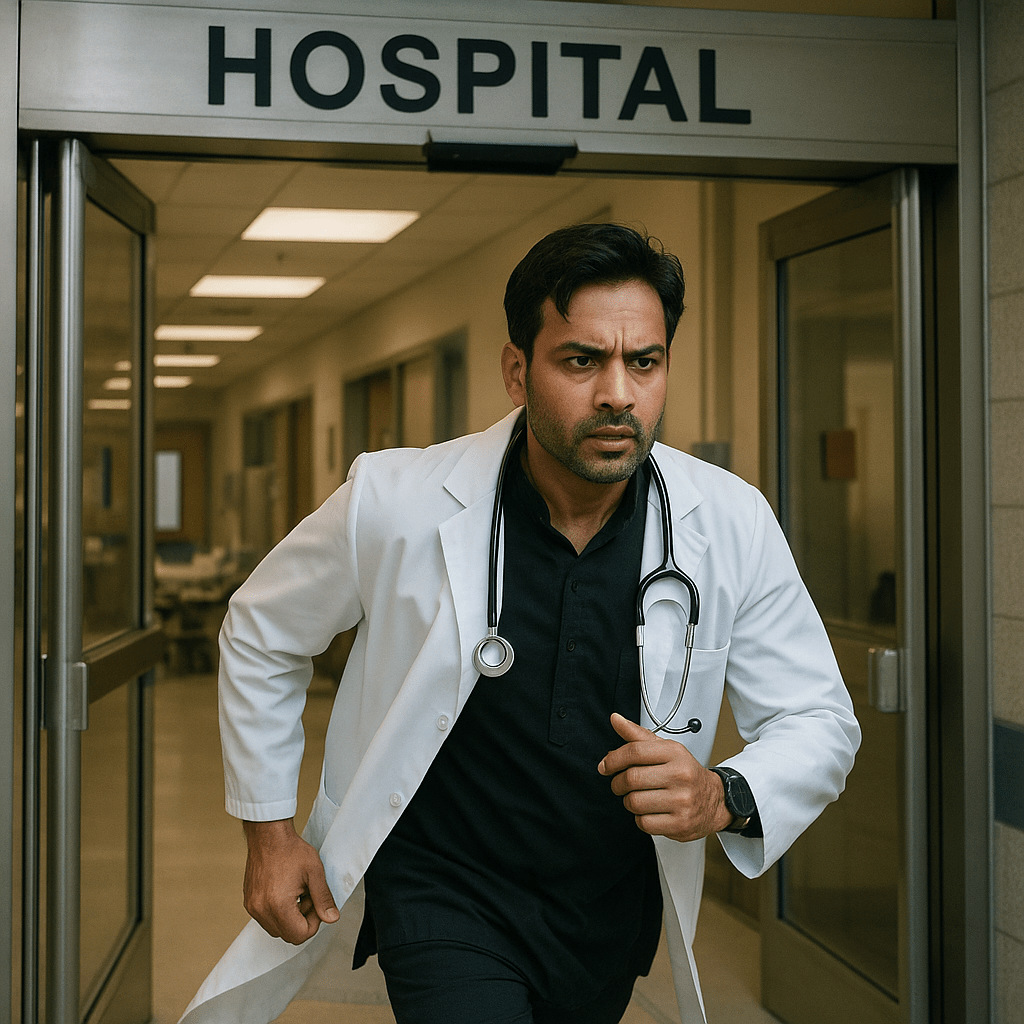
The automatic doors of City General Hospital burst open as Dr. Raghav stepped in, slightly breathless, still dressed in his black ceremonial kurta, now dusted with ash.
His phone had buzzed just as he was lighting the final stick of incense during his son’s cremation. He had turned to the fire one last time, whispered a prayer, and left—his grief wrapped tightly in the folds of his white scarf.
Inside the emergency lobby, chaos reigned. A young boy, no older than fifteen, had been brought in after a horrific accident.
His face was pale, his lips were trembling, and his limbs were lifeless. Around him, family members paced in anxiety, desperation, and mounting fear.
One man in particular, tall and rugged with pain written across his face, turned sharply as Raghav entered.
Please, let me do my work now
“You call this service?” the man barked. “Where were you? My son is dying, and you’re strolling in like this is a morning walk! If something happens to him—you will be responsible!”
Raghav paused for a moment, closed his eyes to gather himself, and said calmly, “I’m very sorry. I wasn’t at the hospital. The moment I received the call, I came as fast as I could. Please, let me do my work now. Time is critical.”
“Do your work? How convenient! What if it were your own son lying there? Would you still be so calm, doctor?”
the man growled, his voice quivering between anger and helplessness. “You people forget we are human beings, not statistics on a clipboard!”
Without answering, Raghav nodded briefly and rushed toward the operating room. His face was stoic, yet his heart pounded—not from urgency alone, but from the pain of what he had just left behind.

As the operation theatre doors closed, silence surrounded them, broken by the mother’s sobs and relatives whispering to soothe the distressed father.
He sank into a chair, covering his face with shaking hands, murmuring, “It’s easy to say ‘have faith’… but how can I when I might lose my only child?”
Inside, the atmosphere was vastly different—clean, cold, and sterile. The beeping monitors, the antiseptic scent, the focused eyes of the medical team.
Dr. Raghav changed into scrubs and scrubbed his hands, his thoughts divided. His own son’s lifeless face had not yet faded from his memory. But he had made a choice. Duty over despair.
“Scalpel,” he said.
“Vitals stable. Internal bleeding detected. We need to work fast,” said the assisting surgeon.
With precision that only decades of experience could provide, Raghav worked. Every stitch was a prayer, every incision a battle against death. The boy’s heart stopped once—briefly—and was revived. The surgery continued. Minutes turned into hours.
Finally, the rhythm of the beeping monitor stabilized. Blood pressure normal. Respiration improved.
He pulled his mask down. “We’ve done it. He’s out of danger.”
The team sighed with relief. Raghav removed his gloves and walked out without a word.

He’s out of danger now,
In the waiting room, he stepped out to meet the family, his face weary but composed.
“The boy is safe. He’s out of danger now,” he said simply, and a faint smile broke across his face for the first time that day.
Gasps, cheers, and cries of gratitude erupted from the family. The mother fell to her knees, hands joined in prayer. The father, speechless for a moment, rushed forward.
“Doctor! Thank you! How long until he can talk? Will he walk again? When can we take him home?”
But Dr. Raghav merely held up a hand, “The nurse will answer your questions. I have to go now.”
And just like that, he turned around and walked briskly away.

The father watched him, confused. “What kind of man is he?” he mumbled. “He just saved my son’s life and can’t even talk to us for two minutes? How arrogant!”
The nurse, still standing beside them, looked up, her eyes moist. “Please don’t be upset,” she said softly. “Dr. Raghav isn’t arrogant. He’s… grieving.”
“Grieving?”
“Yes. This morning… his only son died in a car accident. The call you’re angry about interrupted his funeral. He came here directly from the cremation ground… without completing the rites. And now… he’s going back. To say his final goodbye.”
The world stopped for a moment.
The father froze, his mouth open. The words fell like thunder.
The mother’s sobs ceased.
The relatives stood still.
And suddenly, the earlier outbursts felt like a stain they could never wash away.
Later that evening, as the sky burned orange, the boy’s father stood near the window of the hospital room, watching the traffic go by. His son lay asleep behind him, peaceful, breathing.
He turned to the nurse and whispered, “What kind of strength does it take… to walk away from your son’s funeral to save someone else’s child?”
She nodded. “The kind that not all of us are born with. The kind that silently heals the world.”
He bowed his head. “I judged too soon.”
Moral of the Story:
We are often quick to react, to criticize, and to blame, without knowing the full picture. In our pain, we forget that others may be carrying invisible burdens far heavier than ours. Dr. Raghav showed that sometimes true heroism isn’t in grand gestures—but in silent sacrifices.
So the next time you’re tempted to lash out in anger, take a breath. Perhaps the person you’re confronting is already fighting a battle you know nothing about.
Let empathy be your first response—not judgment.

BE HAPPY… BE ACTIVE… BE FOCUSED… BE ALIVE
If this post inspired you, show some love! 💙
✅ Like | ✅ Follow | ✅ Share | ✅ Comment
www.retiredkalam.com
Categories: story
 Retiredकलम
“Let empathy be your first response—not judgment” I love this ! Very emotional and touching 👍🏻🤝
LikeLiked by 3 people
Thank you so much!
I’m truly glad the message resonated with you. In a world where we often rush to react, choosing empathy first can transform lives—ours and others’.
Your kind words mean a lot 🤝💖
LikeLiked by 1 person
NICE ❤️
LikeLiked by 1 person
Thank you so much, dear.❤️
LikeLiked by 1 person
nice story .
LikeLiked by 2 people
Thank you so much.
LikeLiked by 1 person