


In a world dominated by computers and screens, imagining life without them feels like a memory from long ago.
But let’s take a moment to picture a life without computers, where physical objects and analog experiences shape our everyday lives.
The Pre-Computer Era
Cast your mind back to a time before the digital revolution, a time when the world was a little slower, a little less connected, but undeniably rich in its own right.
Before the advent of computers, life was guided by a different rhythm, one that was dictated by handwritten letters, telegrams, and face-to-face conversations.
Communication had a more deliberate pace, and the world felt like a smaller, more intimate place.
In every industry, from education to finance, tasks were performed manually, requiring patience, diligence, and human interaction.
Data was recorded on paper, stored in massive filing cabinets, and retrieved with great care.
Efficiency was measured by human effort rather than processing speed, and work culture revolved around personal relationships rather than virtual meetings and emails.

Before Bank Computerisation
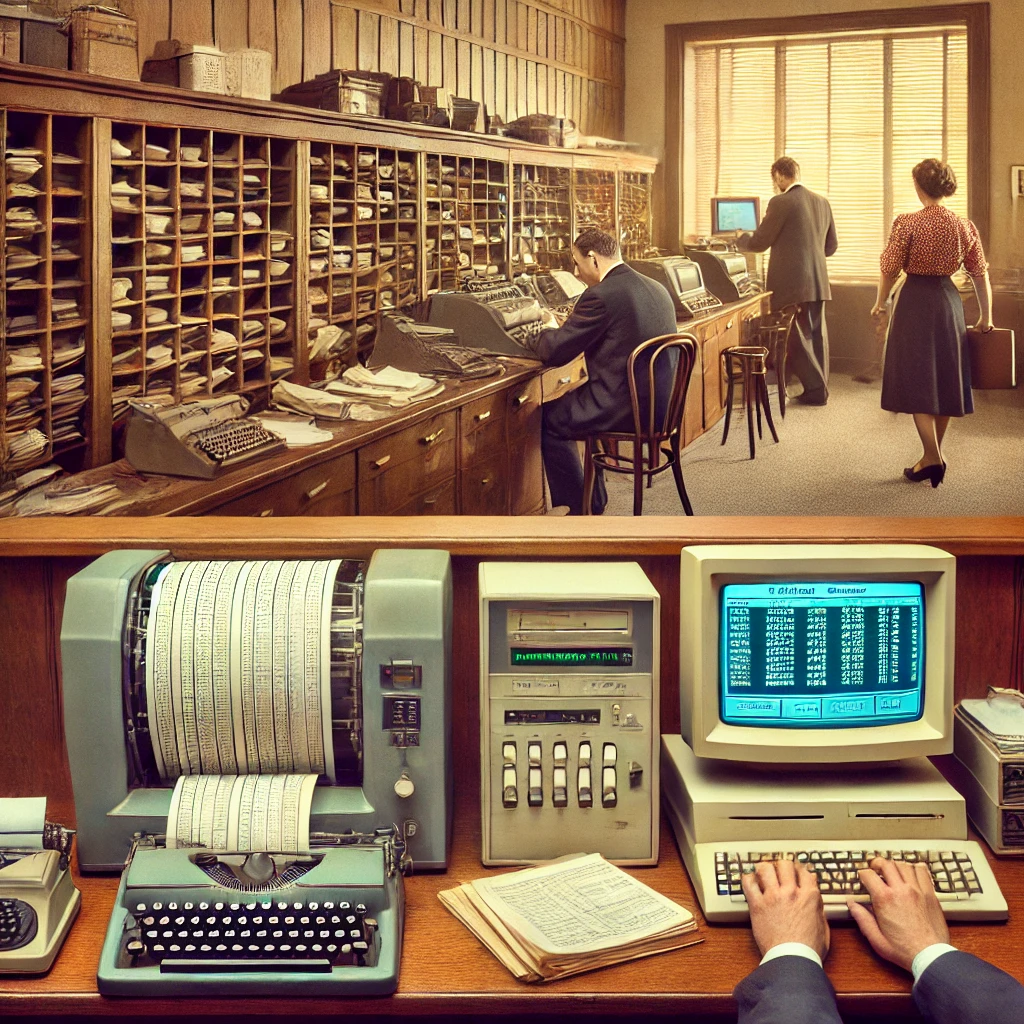
I recall those days vividly, particularly my early professional life in banking. The bank was a place filled with towering ledgers, each page bearing witness to countless account transactions.
Balancing those ledgers was a monthly ritual, a meticulous process that demanded time, patience, and precision. It may sound laborious now, but there was a certain satisfaction in the meticulousness of it all.
The closing of financial statements in March was a grand event, an occasion that brought us all together to work late into the night.
We were rewarded with extra remuneration, but more importantly, we shared a sense of camaraderie and purpose that is hard to replicate in today’s automated world.
Customers, too, had a different relationship with their banks. They visited branches in person, speaking to familiar tellers who knew them by name.
Transactions took longer, but they carried a personal touch that has largely been lost in the digital age.
The Digital Shift
Then came the era of computerization. The introduction of computers into banking transformed everything overnight. The ledgers disappeared, replaced by digital records that could be accessed at the click of a button.
Balancing transactions, which once took hours, could now be completed within minutes.
ATMs eliminated the need for long queues at bank counters, and online banking ensured that financial transactions could be done from the comfort of one’s home.
At first, adapting to this change was a challenge. Many of us who had spent years mastering manual processes had to learn a new way of working. Training sessions, workshops, and trial-and-error became part of the transition.
Some resisted, feeling that the personal touch of banking was being eroded, while others embraced the newfound efficiency and convenience.
Over time, technology has only continued to advance. Artificial intelligence now plays a role in fraud detection, mobile apps allow instant financial management, and blockchain promises a future of secure, decentralized transactions.
The job of a banker today is vastly different from what it was in the pre-digital era. While some elements of human connection have been lost, the convenience, security, and speed of banking have undoubtedly improved.

A Reflection on Change
Looking back, I feel fortunate to have witnessed both worlds. The pre-computer era was defined by human connection and meticulous manual work, while today’s digital age is marked by speed, convenience, and automation.
Each has its strengths and weaknesses, but one thing is certain—technology has forever changed the way we work.
As we move forward, it is essential to balance technological advancement with human values. While we embrace efficiency, we must not forget the importance of personal connections, empathy, and the satisfaction of meaningful work.
So, how has technology changed your job? Has it made life easier, or do you long for the days when human effort defined success?
The evolution continues, and perhaps, in another few decades, we will once again look back at today with the same nostalgia that I feel for my early banking days.

BE HAPPY….BE ACTIVE….BE FOCUSED….BE ALIVE…
If you liked the post, please show your support by liking it,
following, sharing, and commenting.
Sure! Visit my website for more content. Click here
Categories: infotainment


😍Insightful insight, well done for posting, dear friend. I wish you success and brilliance always.
LikeLiked by 3 people
Aww, thank you so much, dear friend! 😊
Your kind words truly mean a lot. Wishing you endless joy, creativity, and brilliance in everything you do. Let’s keep inspiring each other always! 🌟🙏💖
LikeLike
Great Post. It really is amazing when we think about how much things have changed since the early days of our working lives. I cant say career in my case, as I changed careers. But my first job in a big law firm in Glasgow, we all used golf-ball typewriters and throughout the whole organisation there were only 2 computers (mid 1980s) so they could create all the big legal documents. I was talking to a class about this last week … the now obsolete skills we had then. I wonder if I can still use a typewriter eraser without putting a hole in the paper 😆
LikeLiked by 2 people
Thank you so much for sharing your experience—what a vivid picture you’ve painted of those early days in the legal world! The image of golf-ball typewriters clacking away in a bustling Glasgow law firm really brings back memories of a time when precision and patience were everything.
It’s fascinating, isn’t it, how entire skillsets we once relied on—like using carbon paper or expertly wielding a typewriter eraser—have quietly faded into the past. And yet, they were the very tools that shaped our professional foundations. I smiled at your eraser comment… I think I might still have the muscle memory for it, though the risk of punching a hole through the paper is very real!
It’s also wonderful that you’re passing these stories along to a younger generation. They may have never seen a typewriter in action, but understanding where we came from gives such depth to where we are now.
LikeLiked by 2 people
I think the loss of human connection is a tragedy that is hurting all of us.
LikeLiked by 2 people
Absolutely, The rapid pace of technological advancement has brought us incredible convenience, but at a cost we rarely stop to measure—the quiet erosion of human connection.
There was a time when work was as much about relationships as it was about results. Conversations over tea, shared laughter in the break room, even the rhythm of collaboration felt more real, more human.
Today, with emails replacing eye contact and automation replacing interaction, something precious has been lost.
By acknowledging this gap, we take the first step toward restoring it in small, meaningful ways.
LikeLiked by 1 person
Good
LikeLike
Thank you so much for your appreciations.
Your words mean a lot..
LikeLike
❤️❤️
LikeLiked by 1 person
Thank you so much, Dear 😊
I truly appreciate your warm gesture.
It’s a pleasure to connect with you—let’s continue sharing thoughts and positivity.
LikeLiked by 1 person
very nice.
LikeLiked by 2 people
Thank
LikeLike
Subscribe me for great Crypto related content
LikeLiked by 1 person
pappyon internet servisleri para ekonomi thank u
LikeLike
Thank you so much for sharing.
LikeLike
Thank u very much for share
LikeLike
You’re most welcome!
I’m truly glad you took the time to read it. Your appreciation means a lot to me.
Looking forward to sharing more heartfelt pieces with you. 😊
LikeLike