
Friends, our history is rich with stories that are either unknown or lesser-known. These stories carry profound morals and lessons that can shape our lives and sometimes even change our belief systems.
It is my endeavor to share such thoughtful stories that not only entertain but also impart valuable knowledge. Today, I present a brief yet captivating tale from the annals of history.
The Poet and the Emperor
Once, the renowned poet Tulsidas was invited by the Mughal Emperor Akbar to his court. Akbar, intrigued by the legendary poet’s fame, wanted to witness Tulsidas’s supposed magical powers firsthand.
This invitation came on the recommendation of Akbar’s esteemed courtiers, Khan-e-Khana Rahim and Toder Mal, both of whom held Tulsidas in high regard for his spiritual prowess and literary genius.
However, Tulsidas, a devout and humble poet, declined the emperor’s invitation. His refusal was not out of disrespect but a reflection of his belief that his powers, if any, were not meant for public display or to satisfy the curiosity of the emperor.
He believed his devotion and work were meant solely for the service of Lord Rama.
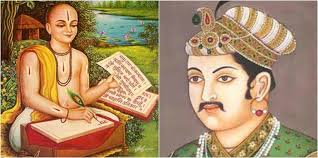
The Poet’s Imprisonment
Akbar, interpreting Tulsidas’s refusal as defiance, was not pleased. In his displeasure, the emperor ordered that Tulsidas be imprisoned. The decision was swift, and Tulsidas found himself confined within the walls of the royal prison.
Despite his confinement, Tulsidas remained steadfast in his devotion. He spent his days in prayer and meditation, continuing his spiritual practices undeterred by his surroundings.
It was during this time of imprisonment that Tulsidas began to compose the Hanuman Chalisa. Each verse he wrote was a testament to his unwavering faith in Lord Hanuman, the mighty devotee of Lord Rama.
The Hanuman Chalisa, consisting of forty verses, became a powerful expression of his devotion and a plea for divine intervention.
The Divine Intervention
Days turned into weeks, and on the 40th day of his imprisonment, a miraculous event occurred. The entire region of Fatehpur Sikri, where Tulsidas was imprisoned, was suddenly surrounded by giant monkeys. These monkeys were not ordinary; they appeared to be driven by an otherworldly force.
They invaded the palace premises, causing chaos and commotion. The palace guards were overwhelmed as the monkeys disrupted the court and created havoc.
The situation escalated to such an extent that the courtiers and guards were at a loss. No one knew how to handle the rampaging monkeys. It was then that someone suggested to Akbar that the chaos might be related to Tulsidas’s imprisonment. They advised the emperor to release the poet immediately.
Freedom and Faith
Akbar, seeing no other solution and perhaps recognizing the divine hand at play, ordered the release of Tulsidas. The moment Tulsidas stepped out of the prison, the monkeys began to retreat. Peace was restored as the monkeys dispersed, leaving the palace grounds and the city.
This miraculous event left a deep impression on Akbar and his court. It was clear that the presence of the monkeys was a manifestation of Lord Hanuman’s power, coming to the aid of his devoted follower, Tulsidas.
This incident not only demonstrated the power of true devotion but also highlighted the bond between Tulsidas and his deity.

Lessons from the Past
The story of Tulsidas and the Hanuman Chalisa is more than just a tale of miraculous intervention; it is a testament to the power of faith and devotion. Tulsidas’s unwavering belief in Lord Hanuman and his composed spiritual verses under duress became a beacon of hope and a lesson in steadfastness.
In our modern lives, this story serves as a reminder of the strength that comes from faith, the power of devotion, and the miracles that can arise from sincere belief. It teaches us that true power lies not in physical strength or magical abilities but in the purity of one’s heart and the depth of one’s faith.
As we reflect on this tale, let us remember that history is filled with such stories that offer wisdom and insight. They entertain us, but more importantly, they guide us and inspire us to live our lives with integrity and faith.
So, friends, let us embrace these stories from our rich past, for they are not just tales of yesteryears but are reservoirs of timeless wisdom. Through them, we can find guidance, inspiration, and the strength to face our own challenges.
In the story of Tulsidas and the Hanuman Chalisa, we find a profound lesson in the power of devotion and the divine protection that comes with unwavering faith.

Categories: infotainment
 Retiredकलम
जय श्री हनुमन्त 🙏🏻🌸🙏🏻
LikeLiked by 2 people
जय श्री राम |
LikeLiked by 1 person
beautiful story. thanks for sharing
LikeLiked by 1 person
Thank you so much for your appreciation.
Your words mean a lot.
LikeLiked by 1 person
🙏
LikeLiked by 1 person
Good night. Sweet Dreams.💕
LikeLiked by 1 person
Thank you for sharing. What a beautiful story. A story with a positive message and the one that is full of hope!
LikeLiked by 1 person
Thank you for your kind words.
I’m glad you enjoyed the story and found it uplifting.
It’s always wonderful to share tales that inspire hope and positivity.
LikeLiked by 1 person
Beautiful story shared
LikeLiked by 2 people
Thank you! I’m so glad you enjoyed the story.
Your kind words are much appreciated.
LikeLike
Tulsidas and Hanuman Chalisa is beautiful story based on trust and divine power.Tulsidas proved his trust on monkey God and under the divine power he released from jail.Nice and interesting story we came to know from your blog.
LikeLiked by 1 person
Thank you so much for your thoughtful comment.
I’m delighted to hear that you enjoyed the story of Tulsidas and the Hanuman Chalisa.
It’s indeed a powerful tale of trust and divine intervention. I’m glad my blog could bring this inspiring story to your attention.
Your appreciation means a lot!
LikeLike
Jai shree Ram
LikeLiked by 1 person
Jai Shree Ram.👍👍
LikeLike
Really interesting esp from a Kenyan❤️
LikeLiked by 1 person
I’m thrilled to hear that you found it interesting, especially coming from a Kenyan perspective.
It’s always heartwarming to know that stories can connect us across different cultures and bring a sense of unity and hope.
Thank you for your lovely comment! ❤️
LikeLike
NICE 💚🧡♥️
LikeLiked by 1 person
Thank you so much.
LikeLike