

Dear friends,
I hope this blog finds you in a cheerful mood.
Today’s writing prompt poses a deceptively simple yet profoundly revealing question: If you could un-invent something, what would it be?
At first glance, the question feels playful—almost like a thought experiment meant for idle conversation. But the longer you sit with it, the heavier it becomes.
Every invention carries consequences, both intended and accidental. To un-invent something is not merely to erase an object; it is to rewind a chain of human behavior shaped around it.
In a world immersed in technological wonders, many might be tempted to target the internet or smartphones themselves.
My focus, however, shifts to a specific phenomenon: social networking—what I often call “social NOTworking.”
Despite its promise of connecting us across vast distances, social networking paradoxically hinders genuine human interaction.
The anonymity of the internet emboldens people to become trolls, hurling insults and judgments they would likely never express face-to-face.
Imagine that same troll sitting next to you—their tone, words, and courage would probably change dramatically. What we lose online is accountability, and with it, empathy.
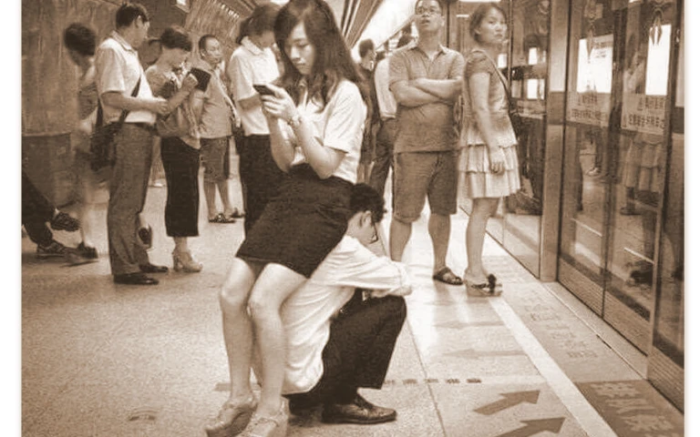
algorithm-driven social media feeds
If I had the power to un-invent one thing, it would not be fire, electricity, or even the internet itself. It would be algorithm-driven social media feeds—the invisible systems designed to capture, hold, and monetize our attention.
This is not a rejection of technology or connection. Social media, in its early days, promised something beautiful: bridging distances, sharing ideas freely, and amplifying unheard voices.
That promise was real. What changed was not our desire to connect, but the machinery behind the screen.
Algorithms are designed to optimize engagement. They learn what keeps us scrolling and feed us more of it.
Psychology and neuroscience show that likes, comments, and notifications activate the brain’s dopamine system in ways similar to gambling.
The result is not just habit, but compulsion. Unlike a cigarette, which openly signals harm, an algorithm smiles politely and asks for “just one more minute.”

The social consequences are increasingly hard to ignore.
Algorithmic feeds favor content that provokes outrage and fear because calm reflection doesn’t travel as fast. This fuels polarization, misinformation, and fractured realities where dialogue turns into shouting across invisible walls.
On a personal level, the damage is quieter but equally profound. Attention is finite. When constantly interrupted, deep thinking suffers.
Creativity requires boredom. Empathy requires presence. Yet digital platforms are engineered to eliminate pauses, filling every empty moment with noise.
I’ve witnessed this shift firsthand.
Just the other evening, my granddaughter was engrossed in her mobile phone when her friends came to invite her to play outside.
“I don’t feel like playing right now,” she said, before returning to her screen. This small moment reflects a larger concern: children are spending less time in physical play and face-to-face interaction, and more time glued to devices.

Serious concerns about emotional intelligence and Social skills
The increasing reliance on social networks has altered how children socialize. Laughter, shared silence, and spontaneous conversation are being replaced by curated images and typed responses.
This raises serious concerns about the development of emotional intelligence and essential social skills.
It is crucial for parents, educators, and society to find balance—where technology enhances life rather than replaces human connection.
In a world dominated by text, the absence of facial expressions makes sincerity difficult to decipher. The warmth of personal interaction is lost in the digital abyss.
Even practical matters suffer. How many important gatherings have we missed because an invitation was buried on a social media feed?
A personal call or a simple message carries a value no algorithm can replace.
My objection is not a rejection of progress,
My objection is not a rejection of progress, but a plea for intentional living. My life does not revolve around what others post online, and meaningful communication should not be sacrificed at the altar of virtual validation.
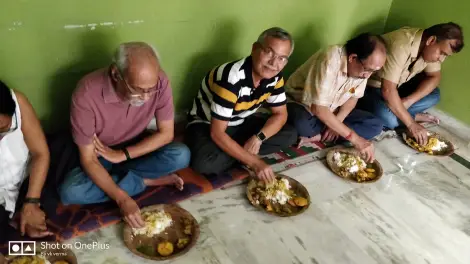
Interestingly, this longing for connection extends beyond the digital world. I often find myself nostalgic about floor-seated meals from my childhood—a time when families gathered informally, sharing food, gossip, laughter, and even playful complaints.
Eating on the floor fostered closeness and authenticity, free from formality.
Science even suggests such practices aid digestion. While dining tables and chairs bring convenience, something human was lost along the way.
Whether it’s the virtual world stripping away emotional nuance or the physical world losing informal togetherness, the underlying theme remains the same: a yearning for authenticity.
Yes, friends, when we explore un-inventing, we uncover a deeper truth—the pursuit of real human connection.
As we navigate progress, let us not forget what makes us human: presence, empathy, conversation, and community.
What do you think? I’d love to hear your thoughts as we continue this conversation about rediscovering genuine connection in a rapidly changing world.
BE HAPPY… BE ACTIVE… BE FOCUSED… BE ALIVE
If this post inspired you, show some love! 💙
✅ Like | ✅ Follow | ✅ Share | ✅ Comment
www.retiredkalam.com
Categories: infotainment
 Retiredकलम
very nice .
LikeLiked by 1 person
Thank you so much.
LikeLike
Your mention of floor-seated meals instantly took me back to my childhood. We really have traded informal togetherness for formal convenience. Technology was supposed to build bridges, but as you rightly called it, ‘social NOTworking’ has built walls instead. I hope we can all find the courage to disconnect a little and reconnect for real. Wonderful writing!
LikeLiked by 3 people
Thank you so much for this heartfelt response.
It means a great deal to know that the memories of floor-seated meals resonated with you—that kind of shared nostalgia reminds us how deeply connection is woven into the simplest moments.
You’re so right: in trading informal togetherness for formal convenience, we’ve gained efficiency but often lost intimacy.
LikeLiked by 2 people
The recurring theme of
My objection is not a rejection of progress
It seems no matter what country you live some form of capitalism eventually wrecks almost everything.
LikeLiked by 3 people
You’re touching on something deeply true—and deeply felt. That line, “my objection is not a rejection of progress,” keeps resurfacing because it names a quiet frustration many of us share. Progress, in its purest sense, is meant to improve human life. But when progress becomes entangled with unchecked capitalism, efficiency and profit often outrun care, balance, and humanity.
LikeLiked by 1 person
Absolutely, I was a programmer by trade and made a living in technology
Capitalism needs some checks and balances
LikeLiked by 2 people
Well said—and coming from someone who’s worked inside the system, that insight carries real weight. When you’ve made a living in technology, you’ve seen both sides: the creativity, problem-solving, and possibility and the way market pressures can quietly distort good intentions.
Capitalism, like technology, isn’t inherently the villain. It’s a tool. But without checks and balances, it tends to optimize for profit over people, speed over reflection, scale over care. The same logic that drives efficient systems can, if left unchecked, flatten nuance and erode the human elements that technology was originally meant to serve.
LikeLiked by 1 person
In an increasingly fast paced & money driven world, these are pushed to us and we took in without any resistance. Progress is good, but it’s going in both wrong & right(a little maybe) direction.
I still eat on the floor with my family, in fact if I eat didn’t have my dinner like that, I don’t feel like eating at all… I intend to follow that always. And my family tend to eat together as much as possible although this is not possible always but we try as much as we can….
LikeLiked by 2 people
I really appreciate you sharing this—it carries a quiet wisdom that feels grounded and lived, not idealized. You’re right: progress itself isn’t the problem, it’s how easily we absorb what’s pushed toward us without pausing to ask whether it actually serves our lives or our values.
The way you describe eating on the floor with your family is especially moving. It’s not just about tradition or habit; it’s about presence, comfort, and connection. That feeling of not being able to eat otherwise says so much—it shows how deeply nourishment is tied to togetherness and belonging. Even the fact that you try, despite modern demands, matters. That effort is a form of resistance, and a meaningful one.
LikeLiked by 2 people
Thanks sir, I try what my elders have passed on to me….but it is not always possible, but I do whatever I can….
LikeLiked by 2 people
That humility says a lot about you. 🌿 Carrying forward what our elders have given us isn’t about perfection—it’s about intention, remembrance, and effort.
Doing what you can, when you can, with awareness and heart, is already a form of respect and continuity. The fact that you try means the values are alive, not just inherited.
LikeLiked by 2 people
Verma ji, Spot on—un-inventing algorithm feeds would reclaim our attention and empathy from the digital abyss! Your nostalgia for floor-seated family meals hits home too; nothing beats that authentic warmth. Wise words for real connection.
LikeLiked by 2 people
Thank you — that means a great deal. 🙏
You’ve captured it perfectly: attention and empathy are the true costs we rarely calculate. Algorithms may optimize engagement, but they quietly erode presence.
And yes, those floor-seated meals carry a wisdom no feed can replicate — shared silence, shared laughter, shared grounding. They remind us that connection doesn’t need efficiency, only sincerity.
Grateful for this exchange. Conversations like this are small acts of resistance — and remembrance.
LikeLiked by 2 people
An inviting and warm opening—this sets the tone for reflection, encouraging readers to pause and explore a question that can reveal deeper truths about themselves.
LikeLiked by 2 people
Thank you so much. I’m really glad the opening resonated with you — creating that sense of pause and gentle curiosity was exactly the intention. Your reflection captures it beautifully.
LikeLiked by 1 person